

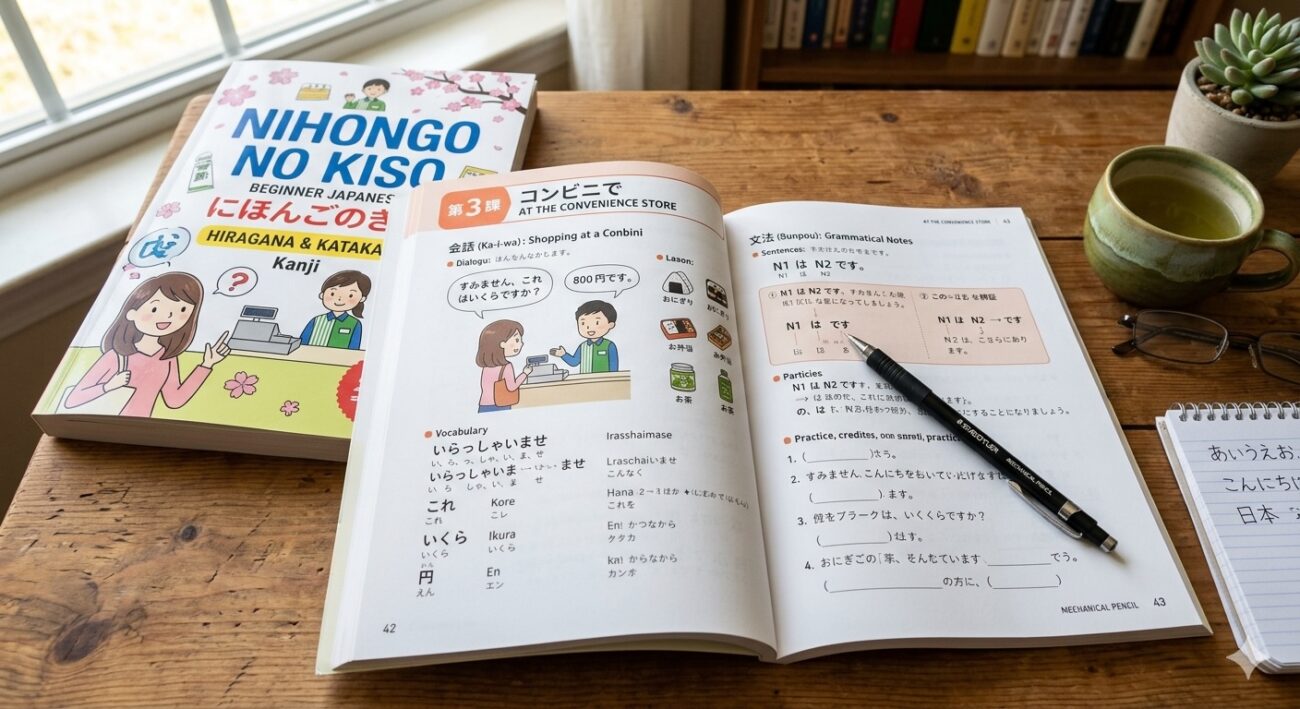
Welcome to your Japanese lesson! Japanese is a rewarding language! While the writing system looks complex, the basic sentence structure and pronunciation are remarkably consistent.
1. The Three Writing Systems
Japanese uses three scripts, often all in the same sentence:
- Hiragana (ひらがな): 46 phonetic characters used for native words and grammar. Start here.
- Katakana (カタカナ): 46 phonetic characters used for foreign loanwords (e.g., kōhī for coffee).
- Kanji (漢字): Over 2,000 logographic characters from China representing concepts or words.
2. Pronunciation Basics
Japanese is “mora-timed,” meaning every syllable gets the same amount of time.
- Vowels: There are only five, and they never change:
- A as in “father”
- I as in “machine”
- U as in “flute”
- E as in “bed”
- O as in “more”
3. Basic Sentence Structure: SOV
English uses Subject-Verb-Object (“I eat an apple”). Japanese uses Subject-Object-Verb (“I apple eat”).
Key Sentence Pattern: A wa B desu (A is B)
- Watashi wa Anna desu. (I am Anna.)
- wa (は): A “particle” marking the topic (“As for me…”).
- desu (です): The polite form of “to be”.
4. Essential Phrases & Greetings
| English | Japanese (Romaji) | Hiragana/Kanji |
|---|---|---|
| Hello / Good Afternoon | Konnichiwa | こんにちは |
| Thank you (Polite) | Arigatō gozaimasu | ありがとうございます |
| Excuse me / Sorry | Sumimasen | すみません |
| Nice to meet you | Hajimemashite | はじめまして |
| Yes / No | Hai / Iie | はい / いいえ |
| What is this? | Kore wa nan desu ka? | これはなんですか? |
5. Numbers (1–10)
- Ichi (いち)
- Ni (に)
- San (さん)
- Yon/Shi (よん/し)
- Go (ご)
- Roku (ろく)
- Nana/Shichi (なな/しち)
- Hachi (はち)
- Kyū (きゅう)
- Jū (じゅう)
