

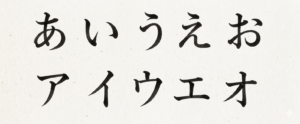
Japanese writing is a unique blend of three different systems – Hiragana, Katakana, and Kanji – that work together in a single sentence to provide meaning, sound, and grammar.
1. Hiragana (ひらがな)
Hiragana is the first script children and beginners learn. It is a phonetic syllabary, meaning each character represents a specific sound rather than a concept.
- Total Characters: 46 basic characters.
- Usage: Used for native Japanese words, grammar particles, and verb endings.
- Example: Arigatou (thank you) is written as ありがとう.
2. Katakana (カタカナ)
Katakana represents the exact same set of sounds as Hiragana but is used for specific roles, primarily related to modern or foreign concepts.
- Total Characters: 46 basic characters.
- Usage: Used for foreign loanwords (like “coffee” or “taxi”), names of foreign people/places, onomatopoeia, and emphasis.
- Example: Amerika (America) is written as アメリカ.
3. Kanji (漢字)
Unlike the first two, Kanji characters are logograms borrowed from Chinese that represent whole words or ideas.
- Total Characters: Thousands exist, but about 2,136 “daily use” characters (Joyo Kanji) are required for standard literacy.
- Usage: Used for the core “meaning” of a sentence—mostly nouns, verb roots, and adjectives.
- Example: The word for “mountain” is 山 (yama).
Summary Comparison Table
| Feature | Hiragana | Katakana | Kanji |
|---|---|---|---|
| Origin | Simplified cursive | Simplified parts of kanji | Ancient Chinese symbols |
| Primary Use | Grammar & native words | Foreign words & emphasis | Concepts (nouns/verbs) |
| Quantity | 46 characters | 46 characters | 2,000+ characters |
How They Work Together
In a typical sentence, you will see all three scripts combined:
私はアメリカに行きます。
(Watashi wa Amerika ni ikimasu) — “I am going to America.”
- 私 (Kanji): “I”
- は (Hiragana): Grammar particle (topic marker)
- アメリカ (Katakana): “America” (loanword)
- に (Hiragana): Grammar particle (direction)
- 行き (Kanji + Hiragana): “Go” (Kanji is the root, Hiragana is the ending)
- ます (Hiragana): Politeness marker
Note on Rōmaji: While not a native script, Rōmaji (Roman letters) is often used to help beginners read Japanese sounds using the English alphabet.
