

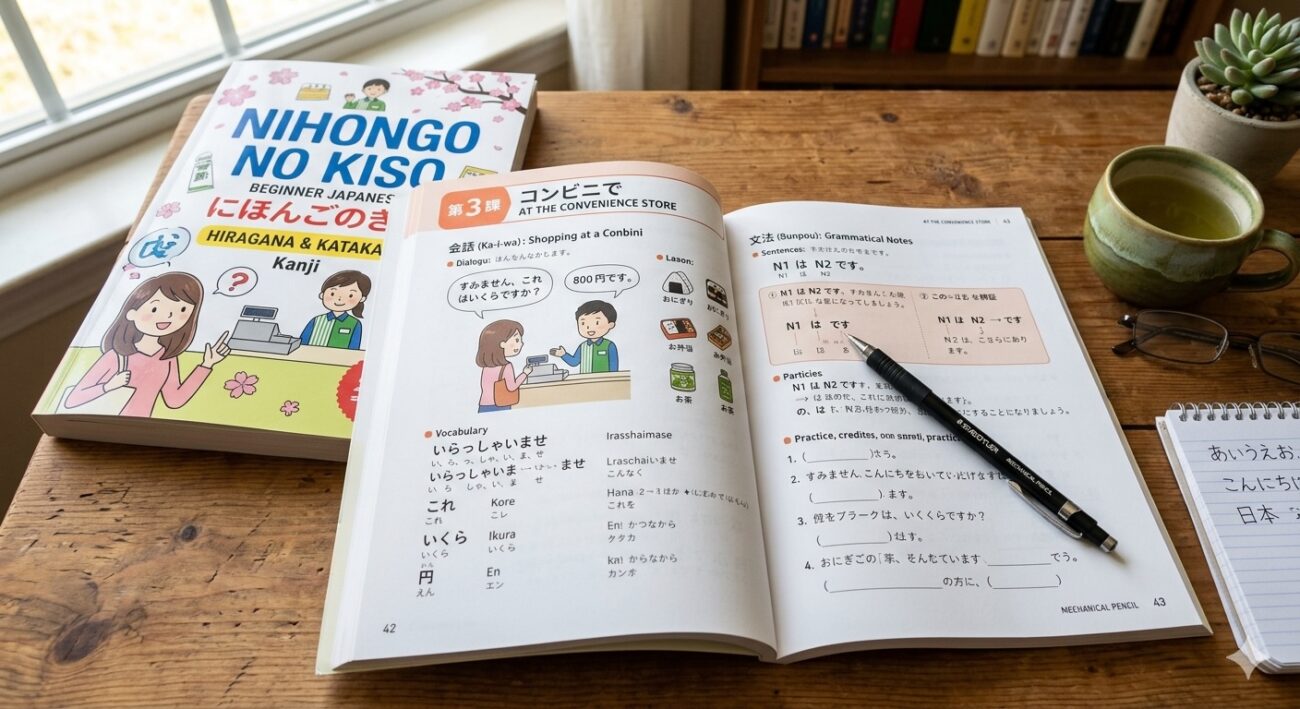
In this lesson, we’ll learn how to point at things, ask basic questions, and use the most important grammar “glue”: Particles.
1. Pointing at Things (Kore, Sore, Are)
Japanese uses three different words for “this” or “that” depending on how close the object is to the speaker.
- Kore (これ): This (near me).
- Sore (それ): That (near you).
- Are (あれ): That over there (far from both of us).
Sentence Pattern:[Object] wa nan desu ka? (What is [Object]?)
- Kore wa nan desu ka? (What is this?)
- Sore wa hon desu. (That is a book.)
2. The Question Particle: Ka (か)
In English, we change our word order to ask a question. In Japanese, it’s much easier: just add ka to the end of a statement. It acts like a spoken question mark.
- Statement: Anata wa Anna desu. (You are Anna.)
- Question: Anata wa Anna desu ka? (Are you Anna?)
3. Essential Particles: No (の) and Mo (も)
Particles are short sounds that follow a noun to tell you its role in the sentence.
- No (の) – Possession: It works like “‘s” in English. It connects two nouns.
- Watashi no hon. (My book / The book of me.)
- Anna-san no kuruma. (Anna’s car.)
- Mo (も) – “Also” or “Too”: Replace the particle wa with mo to say “also.”
- Watashi mo gakusei desu. (I am also a student.)
4. Useful Nouns for Practice
| English | Romaji | Hiragana |
|---|---|---|
| Book | Hon | ほん |
| Water | Mizu | みず |
| Student | Gakusei | がくせい |
| Teacher | Sensei | せんせい |
| Friend | Tomodachi | ともだち |
| Phone | Denwa | でんわ |
5. Culture Tip: Honorifics (-san)
In Japanese, you rarely call someone by just their name. It’s polite to add -san to the end (like Mr. or Ms.).
- Tanaka-san (Mr./Ms. Tanaka).
- Note: Never use -san on your own name!
Ready for a quick challenge? How would you say “This is my book” using the words and particles above?
